Joining for the first time
The company is not in the books yet, so it has to be created correctly before anything can be invoiced to it.
- Tally
- VAT registry
- Customer created
- Invoice
- Peppol
TALLY· MAKE.COM· BILLIT· PEPPOL· ASANA· MICROSOFT 365· GOOGLE DOCS
My client runs a community for entrepreneurs. Members join for a year, they pay as companies rather than as people, and they expect to be welcomed like people rather than like companies. I wired their sign-up forms into Billit, Asana and Microsoft 365 so that a signed form becomes a verified customer, an invoice delivered over Peppol, a subsidy document, a welcome mail, and a week of follow-up that schedules itself.
The problem
The form was never the problem. Someone filled it in, signed it, and from that moment on a person had to carry the new member through four different systems by hand. The member saw a confirmation screen. Behind it, nothing had happened yet.
Eight steps for one member. The last two are the ones that quietly get dropped, because they happen after the money has already arrived.
Why it was not a simple job
Someone joining for the first time, someone renewing for another year, and someone coming in halfway on a half membership are not variations on a form. They are different amounts, different records, and in one case a company that does not exist in the books yet. So they do not share a form. Each situation has its own, and the member is sent to the right one before they type anything.
And enrolling is only the first half. Being a member means turning up to things, which is its own flow with its own confirmation.
The company is not in the books yet, so it has to be created correctly before anything can be invoiced to it.
The company already exists. Nothing is created, nothing is duplicated, and the new year is billed against the record that is already there.
Joining part-way through the year. Billed as a fraction of the same product lines, not as a hand-edited invoice with a number typed over it.
Members pick which events they want to join. The confirmation and the calendar invite arrive together, so it lands in the diary instead of in the inbox.
Four situations. Nobody has to know which one they are in. The link they were sent already knows.
What I built
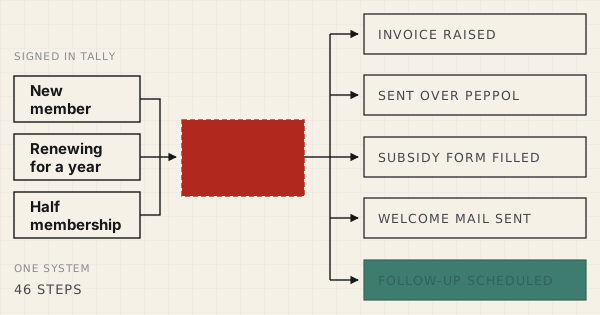
Concretely: the Tally form posts straight into Make.com. Make.com looks the member up, checks the company against the official VAT registry when it does not know it yet, creates or finds the customer in Billit, raises the invoice with a fourteen day term, generates the subsidy document from a Google Docs template with that member's own amount in it, sends the welcome mail from the community's own Microsoft 365 address with both PDFs attached, hands the invoice to Peppol, and opens the follow-up work in Asana with the invoice itself attached to the task.
Four connected scenarios. The sign-up chain alone is forty-six steps. They already paid for every one of these tools. I did not replace anything. I made them talk.
One signature at the left. Five systems at the right, all of them already theirs.
The part I care about most
These members are businesses, and a business invoice has to name the business correctly. Not roughly correctly. The legal name, the street, the number, the postcode and the country all have to match what sits against that VAT number, or the invoice is wrong in the books and the Peppol delivery has nothing solid to land against. People do not type their own company name the way the registry holds it. They abbreviate, they drop the legal form, they give the office they work from rather than the seat of the company.
So the automation does not build the customer record from the form. When the company is already a customer, it uses the record that exists and creates nothing. When it is not, it takes the VAT number to the official registry, and builds the customer in Billit out of the answer that comes back. The form supplies the person. The registry supplies the company.
An invoice with a slightly wrong company on it is not a small mistake. It is a correction, a credit note, and a conversation with an accountant, months later, about a member who joined and never noticed.
What the member actually receives
The nicest part of this build is not the invoicing. It is that the community can help a member claim part of their membership back through a public subsidy scheme, and used to do it by filling in the same document by hand for every single person. Now the automation reads the amount off the invoice it just raised, drops it into the template with the member's company name, exports it as a PDF, and sends it out attached to the welcome.
And when the Peppol delivery fails, the automation does not go quiet. It mails a human, with both documents already attached, so the invoice still goes out that day. An automation that hides its own failures is worse than no automation.
The part most automations skip
Welcoming someone into a community is not a system job. Adding them to the group chat is a person with a login. Introducing them to the other members is a person writing a message. Those are exactly the two things that slip, because they happen days after the payment, when the sign-up no longer feels new.
So the automation schedules them. Not as vague reminders, but as tasks that already carry everything the person needs to do them.
Filed under the member, dropped into the payment follow-up list, and thirty seconds later the totals and the PDF are attached to it. The wait is deliberate: it gives the invoicing system time to finish rendering the document before it is fetched, rather than grabbing a half-made one.
Add the new member to the group chat. The task carries the steps, in order, including the exact format the phone number has to be in. Whoever picks it up does not need to remember, and does not need to ask.
Introduce the new member to the community. The announcement is already written into the task, waiting for a name and a personal line. The blank page never happens.
What changed
Same invoice, same subsidy document, same mail, whether they sign up during a busy launch week or at half past ten on a Sunday night.
One company, one record, built from the registry rather than from a text field. No near-duplicates, no corrections later.
The two things that used to slip now arrive as dated tasks with their own instructions, days before anyone would have thought of them.
What they own now
The sign-up forms live in their Tally account, where they can change a question without telling me. What a membership costs, and what it is made of, lives in Billit, where their bookkeeping already sits. Change the product there and the next member is invoiced the new way. There is nothing to sync and nothing to send over.
What still comes back to me is the wording of the welcome mail and a kind of membership that does not exist yet. That is deliberate, and it is the line I try to hold on every build. An automation nobody but its builder can change is not an asset, it is a dependency.
Almost an hour of assembly per new member, now down to seconds. And nothing forgotten in the week that follows.
If someone can say yes to you in one click and it still takes a week of somebody's attention to make that yes real, the gap between those two things is where your members quietly get a worse experience than you think. Book a free audit call and I will map it with you.
Get your free audit call →