A wedding
One hire rate, and by far the longest occupancy. The building is held from the evening before to the day after, and from much earlier still if they take the morning as well.
- Tally
- Window worked out
- Calendar checked
- Quote mailed
- Asana task
TALLY· MAKE.COM· GOOGLE CALENDAR· EENVOUDIG FACTUREREN· ASANA
My client hosts and caters events at their own venue. Weddings, parties, corporate days and farewell receptions, in the same building, priced completely differently. I wired their quote form into their calendar, their invoicing catalogue and their Asana board, so that asking for a price stopped being a conversation and became a form that answers itself.
The problem
You cannot publish a price list for events, because there is no such thing as a standard event. What kind is it, on what date, for how many people, how many of those are children, do they want breakfast, lunch, dinner, drinks, all of it or only some of it, are they bringing their own caterer, does the building need cleaning afterwards. Every one of those answers moves the price.
So every enquiry opened a thread, and the thread ran for days before anybody could put a number on paper.
Between half an hour and half a day of somebody's attention per enquiry, most of it spent asking the guest questions the guest could have answered themselves.
Why it was not a simple job
There was software for this. Proper quoting software, with a licence fee to match, and it wanted to become the place where their events lived. Which meant it would have pushed Asana out, and Asana is where the team actually works. Buying it would have solved the quote and broken the workflow around the quote.
So the job was never "build them a quoting tool." It was: let the guest answer the questions themselves, and let the tools they already pay for do the rest. What makes that hard is that no single answer sets a price. The event type, the date, the season, the day of the week, the number of days, and whether that date happens to be a public holiday all combine into one hire rate out of thirteen. Then the food is priced per head, split between adults and children, across thirty-three separate lines.
One hire rate, and by far the longest occupancy. The building is held from the evening before to the day after, and from much earlier still if they take the morning as well.
Here the date sets the price. High season or low, a weekday, a single weekend day, a full weekend, or a public holiday. Six rates, and nobody has to look up which one applies.
Priced by half days. Morning, afternoon, evening, or several days back to back. The half days they pick also decide how long the venue is held for them.
One flat rate. No season, no weekend surcharge, no arithmetic. Somebody arranging a funeral gets a price the same day and is never put through a negotiation.
Four kinds of event. The guest fills in one form and never finds out which route they were on.
What I built
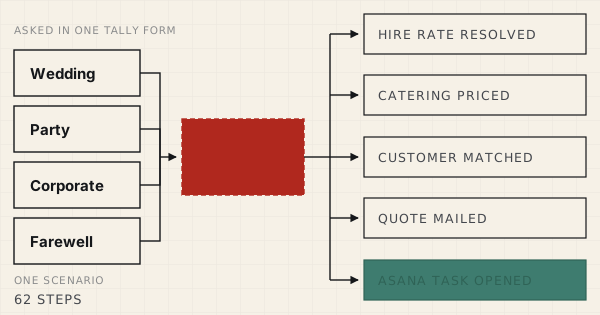
Concretely: the Tally form posts straight into Make.com. Make.com reads the answers, works out how long that particular event actually holds the building, and asks Google Calendar whether it is free for exactly that window. If it is, it checks whether the date is a Belgian public holiday, resolves which of the thirteen hire rates applies, and turns every box the guest ticked into a quote line. It looks each line up in the client's own invoicing catalogue, so the wording, the unit price and the VAT come from there rather than from the form. If a VAT number was given, it strips it down to digits, validates it against the official register, and finds or creates the company as a customer. Then it creates the quote, has the invoicing system mail it to the guest ready to sign, opens a task on the Asana board carrying the head count, the totals and a link to the quote, and attaches the quote PDF to that task.
Sixty-two steps in a single scenario. They already paid for Tally, for the calendar, for the invoicing tool and for Asana. Nothing new was bought and nothing was replaced. I made them talk.
The guest fills in one form on the left. Four systems answer on the right, and all four of them were already theirs.
The part I care about most
An instant quote is only a good idea if the venue is actually available. Otherwise the automation gets faster at making a promise the client has to take back, which is worse than being slow.
So before anything is priced, the scenario works out what the requested event really costs in calendar time. A wedding does not occupy an afternoon, it holds the building from the evening before to the day after, and from sixteen hours earlier again if the couple booked the morning. A corporate day occupies exactly the half days it was booked for, morning, afternoon, evening, or a run of days. Only once that window exists does it ask the venue's own Google Calendar whether anything is already sitting inside it.
If something is, no quote is made. The guest gets a mail the same minute: the date has gone, here are the free dates, and here is the form again if you can move.
A quote for a date you cannot host costs exactly the same to send, and a great deal more to take back.
Where the prices actually live
There are no prices in the form. Every question on it is named after a product code in the client's own invoicing catalogue. Tick the dessert buffet and the form does not send back "dessert buffet, fourteen euro a head." It sends back a code, and the word true.
Make.com takes every code that came back true, looks it up in the catalogue, and builds the quote line out of what it finds there: the wording, the unit price, the VAT rate. Children are priced off their own separate set of codes, so a table of forty with twelve children at it gets twelve lines at the children's rate without anybody counting heads twice.
Which means a price change happens where it always happened, in the tool where their bookkeeping already sits. The next quote uses it. Nobody has to open the automation.
The automation never decides what anything costs. It only decides which lines belong on this quote.
The part most automations skip
A quote sitting in an inbox is not a booking. Somebody has to call. And the whole reason the client would not give up Asana is that Asana is where "somebody has to call" turns into somebody actually calling.
So the last thing the scenario does is open the work. Not a notification. A task with everything already in it.
The event date and the guest's name, or the full date range when it runs over more than one day. Filed in the right project and section, assigned to someone, with two more people following it so it is never one person's secret.
Contact name, mail and phone. A direct link to the quote. Whether cleaning is included, and whether they are on the in-house catering or bringing their own. Head count, adults, children, event type and quote total sit in the board's own fields, so the pipeline can be sorted and filtered by them.
The PDF is pulled back out of the invoicing system and attached to the task, so whoever picks up the phone is reading the same document the guest is looking at.
What changed
What used to be a week of mail is now one form, filled in whenever it suits them, at whatever hour they are actually thinking about their wedding. Nobody has to ask how many children are coming.
Same rates, same catering lines, same VAT, whether it is the first enquiry of a quiet Tuesday or the fourth one that afternoon.
A date that is already taken never becomes a quote, and the guest hears so within the minute, with the free dates in the same mail.
What they own now
What an event costs lives in their invoicing tool, next to their bookkeeping. What the guest is asked lives in their Tally form. Both were already theirs before I arrived, and changing either one takes effect on the very next enquiry. There is nothing to sync and nothing to send over.
What still comes back to me is a genuinely new kind of event, or a new rule about how a date is priced. That is deliberate, and it is the line I try to hold on every build. An automation nobody but its builder can change is not an asset, it is a dependency.
Between thirty minutes and half a day per offer, down to the time it takes to fill in a form. And no back and forth by mail or phone before the number arrives.
If your quotes need a conversation before they need a calculation, most of that conversation is questions the customer could have answered themselves. Book a free audit call and I will map it with you.
Get your free audit call →